The $5M ARR Inflection Point: Why Standard Liquid Themes Hit Limits
For e-commerce brands scaling past $5M in annual recurring revenue, the standard monolithic storefront begins to show friction. What once felt like a frictionless setup—installing apps from the Shopify App Store, customizing Liquid templates, and deploying quick marketing scripts—transforms into an operational bottleneck.
As enterprise marketing teams request dynamic personalization, multi-currency localization, and lightning-fast international delivery, monolithic Shopify Liquid themes often degrade. Third-party apps inject unminified JavaScript bundles, cumulative layout shifts (CLS) creep up, and mobile conversion rates stagnate.
At this crossroad, founders and digital leaders face a defining architectural decision: should they scale up within Shopify Plus using custom Liquid and Hydrogen, or decouple the frontend completely with a headless Next.js storefront?
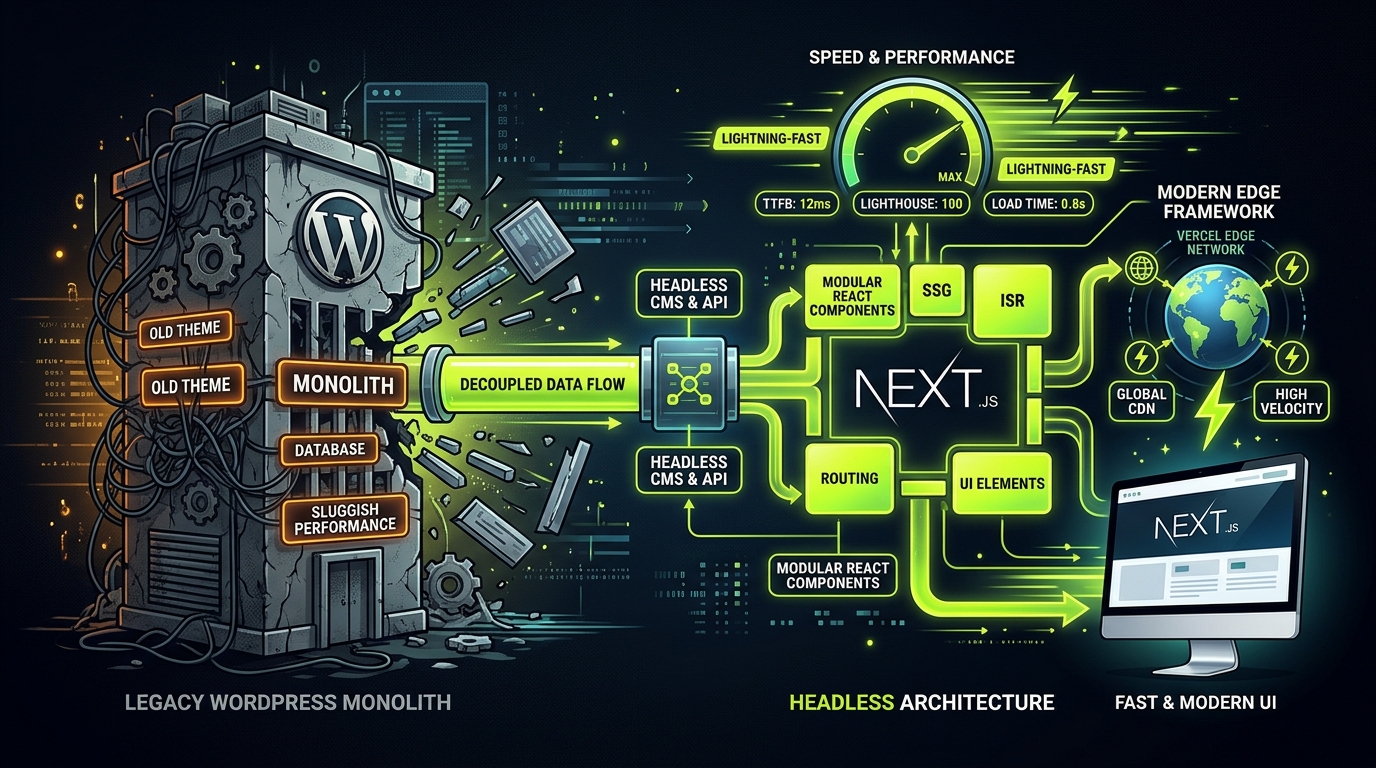
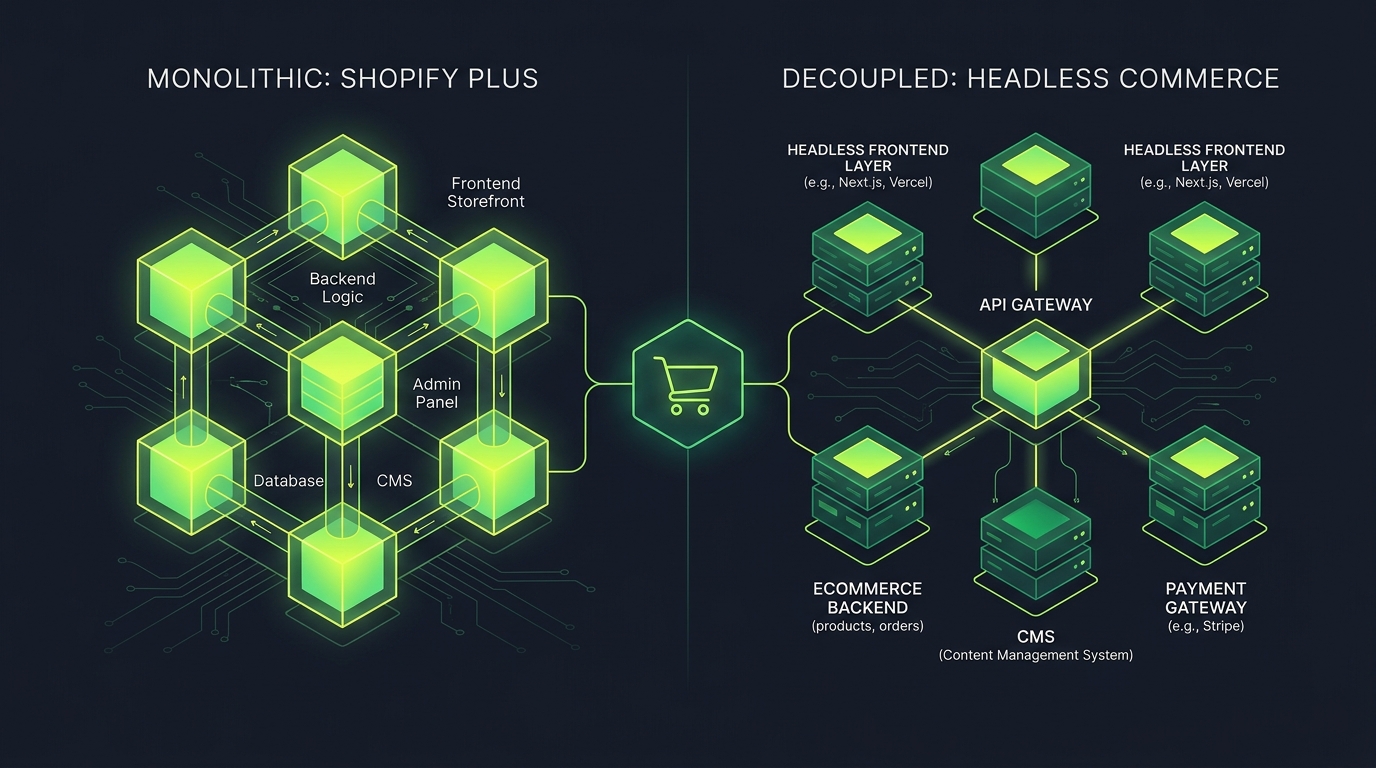
Monolithic Liquid vs Headless Next.js Architecture
Understanding the fundamental trade-off is critical:
- Monolithic Shopify Plus (Liquid Themes):
- Frontend and backend live in the same tightly-coupled environment.
- Fast to launch, native support for 99% of Shopify App Store plugins without engineering glue code.
- Limited by Shopify’s rendering engine and app-script injection hooks.
- Slower TTFB on globally distributed traffic when relying heavily on server-rendered Liquid tags with dynamic loops.
- Headless Commerce (Next.js Storefront + Shopify Storefront API):
- Frontend runs on edge networks (Vercel, Cloudflare, AWS) via Next.js App Router and React Server Components.
- The backend is purely transactional: Shopify manages checkout, inventory, discounts, and customer databases via GraphQL.
- Complete design freedom, sub-second global page loads, and zero unvetted third-party JavaScript bloat.
- Requires ongoing engineering expertise and custom integrations for app functionality like reviews, search, and loyalty programs.
Real Total Cost of Ownership (TCO) Breakdown
Many agencies sell headless commerce as a universal panacea while omitting the ongoing operational overhead. Here is the realistic 3-year TCO comparison:
| Metric | Shopify Plus (Custom Liquid) | Headless Shopify (Next.js) |
|---|---|---|
| Initial Build Investment | $25,000 – $60,000 | $65,000 – $140,000 |
| Shopify Platform License | $2,000 – $2,500/mo | $2,000 – $2,500/mo |
| Frontend Hosting & CDN | Included in Shopify | $200 – $800/mo (Vercel/AWS) |
| Third-Party Middleware | Minimal | $500 – $2,000/mo (CMS, Algolia, Builder) |
| Engineering Maintenance | Low (Internal or retainer) | Dedicated front-end engineer required |
| Average Mobile Speed Score | 35 – 55 | 85 – 98 |
Page Speed & Core Web Vitals Impact on Conversion Rates
Every 100ms reduction in mobile page load time yields an average 1.1% lift in e-commerce conversion rates.
When your storefront runs on Next.js with incremental static regeneration (ISR) and localized edge caching, product detail pages (PDPs) and collection pages load near-instantaneously (<400ms). Customer bounce rates drop dramatically, especially on paid ad traffic from Meta and Google Shopping where mobile visitors abandon sites taking longer than 2.5 seconds to interact.
However, a fast storefront that breaks Shopify checkout creates friction. That is why modern headless architectures retain Shopify's native, battle-tested checkout domain while handling browsing, catalog discovery, and cart states on edge-rendered React components.
The "Headless Trap": When You Should NOT Go Headless
Do not go headless if:
- Your team lacks in-house engineers or an established retained agency partner like Elvantro.
- Your marketing team relies on installing and testing 10+ third-party Shopify apps every quarter without developer involvement.
- Your annual revenue is under $3M, where the speed gains rarely justify the higher initial build and maintenance capital.
The Strategic Recommendation
If your annual revenue exceeds $5M, your mobile ad spend is significant, and you require bespoke user experiences, internationalization, or Omnichannel integration, headless Next.js delivers the highest ROI on conversion lift and brand prestige.
If your priority is speed-to-market and low technical debt, an engineered Shopify Plus custom theme with strict third-party script governance remains the most capital-efficient path.